IEEE Internet of Things Journal — Accepted Paper
Intra-Body Communication for the Internet of Medical Things: A Survey of Communication Modalities, Security, and Reliability
Authors: Mohammad Alhussan, Francesca Boem, Anna Maria Mandalari
Journal: IEEE Internet of Things Journal
Status: Accepted for publication
Article Type: Survey Article
DOI: 10.1109/JIOT.2026.3739056
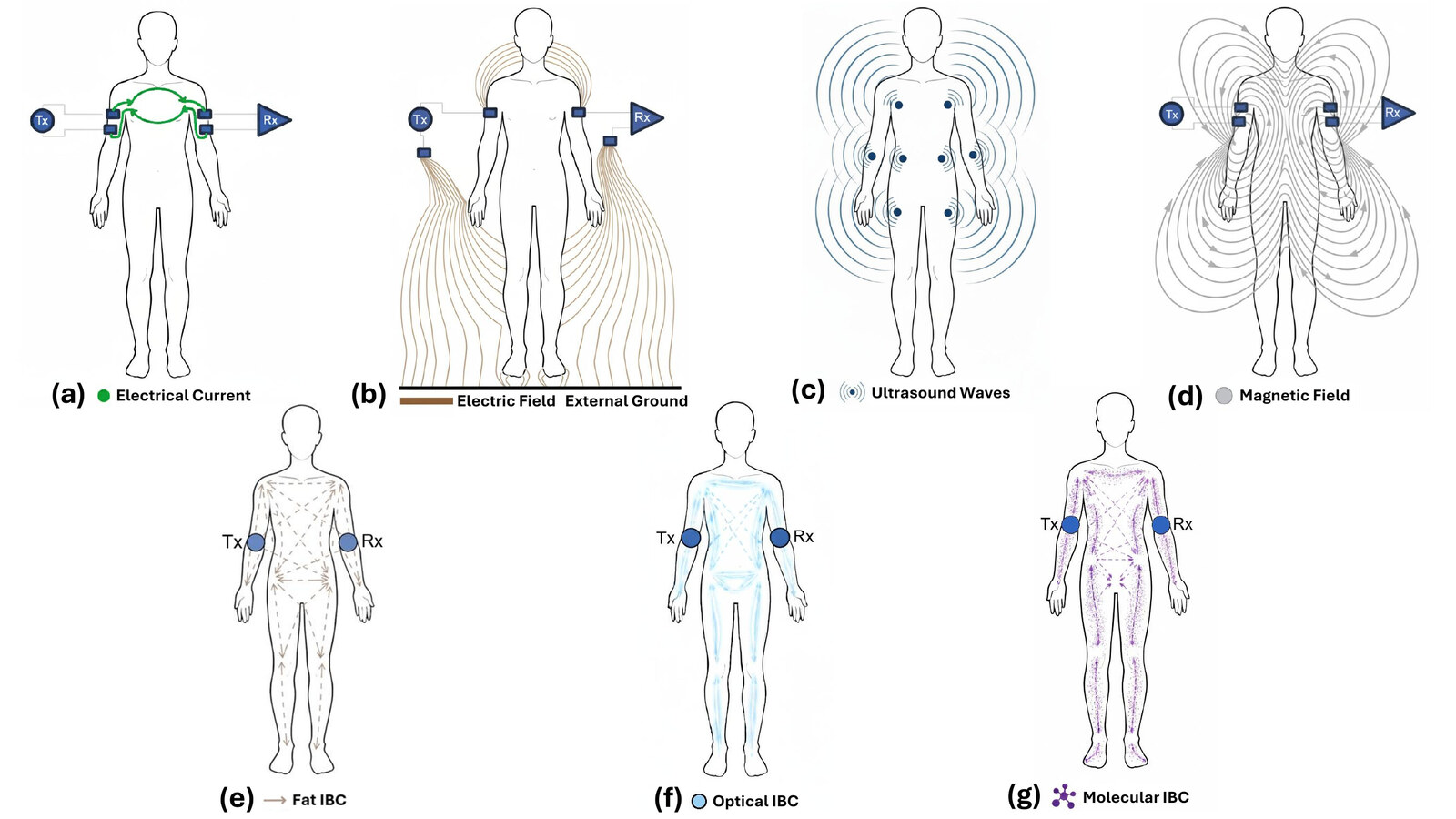
Taxonomy of Intra-Body Communication modalities, including galvanic, capacitive, ultrasound, magnetic resonant, fat-based, optical, and molecular communication.
Overview
The Internet of Medical Things enables continuous monitoring, remote management, and data-driven interventions using wearable and implantable medical devices. However, widespread reliance on short-range radio technologies such as Bluetooth Low Energy exposes body area networks to eavesdropping, physiological data manipulation, and Denial-of-Service attacks, with direct implications for patient safety and privacy.
This survey examines Intra-Body Communication as an alternative communication paradigm that uses the human body as a transmission medium. It classifies major IBC modalities, surveys applications across implants, wearables, assistive systems, and the Internet of Bio-Nano Things, and relates IBC to attack surfaces observed in BLE-based systems.
The paper compares IBC and radio-frequency body area networks across security, reliability, throughput, and interference resilience. The synthesis shows that reported IBC links range from tens of kb/s to Mbps depending on the modality, with Fat-IBC reaching up to 92 Mb/s, while GC-IBC and CC/EQS-HBC offer stronger body-confined robustness and lower BER trends than BLE/SmartBAN.
The review positions IBC as an enabling technology for connected medical devices and identifies open challenges in validation, safety assessment, multi-node coordination, system integration, and standardisation.
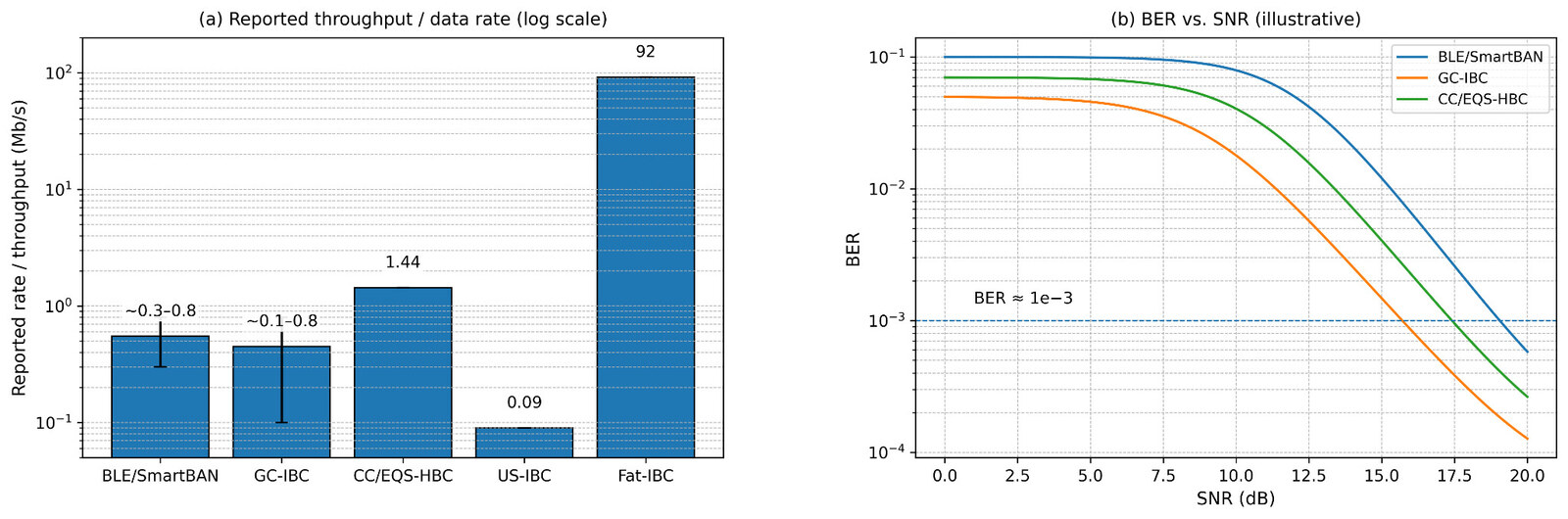
Reported throughput and illustrative BER-versus-SNR comparison across BLE/SmartBAN and selected IBC modalities.
Resources
- Read the paper via DOI — the IEEE record will become accessible through this permanent link when online publication is complete.